Jul 28, 2026
Team USA
The Trailblazers of Montreal: 50 Years Since Women Made Olympic Rowing History
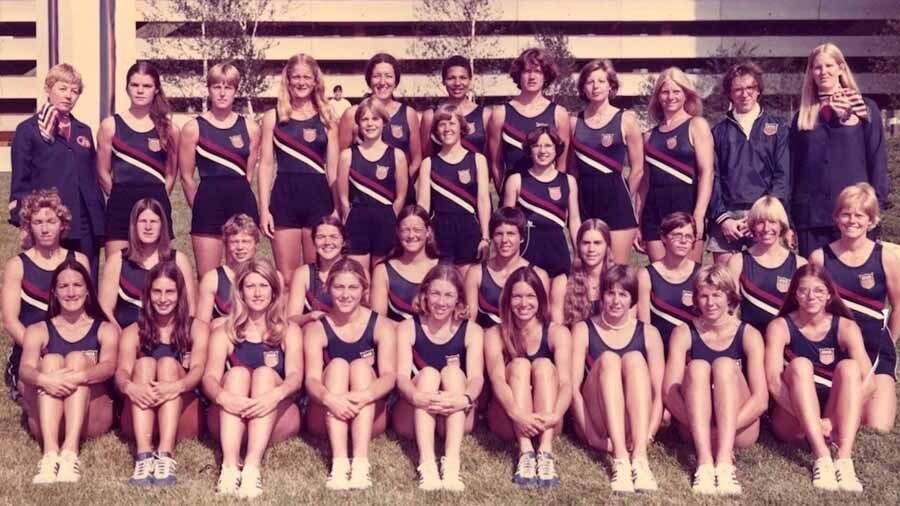
For nearly eight decades, Olympic rowing was a sport reserved exclusively for men. That changed in July 1976, when 23 American women competed in the first Olympic rowing regatta to include women in Montreal. Their arrival on the Olympic stage challenged long-held misconceptions and opened the door for generations of women in rowing.
The women of Montreal were true trailblazers. At the time, women were not permitted to race the full 2,000-meter Olympic distance because it was widely, and incorrectly, believed to be "too physically challenging." Although rowing had been part of the Olympic program since 1896, women raced for the first time in six events over 1,000 meters, while men competed in eight events over the full 2,000-meter distance.
The women's distance was not extended to 2,000 meters until the 1988 Olympic Games, and full gender parity in Olympic rowing was not achieved until Tokyo 2020, held in 2021, when women and men raced the same seven events.
The Montreal Olympic Games came just one year after the legendary Red Rose Crew captured silver at the 1975 World Championships, establishing the United States as a rising force in international women's rowing. In Montreal, 23 American women competed across all six events, earning two medals: silver in the women's single sculls and bronze in the women's eight. Their impact extended far beyond the results—they helped shape the future of women's rowing.
Women’s Single Sculls
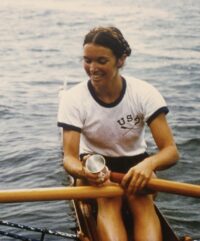
Joan Lind became the first American woman to win an Olympic Medal in rowing at this regatta, finishing in 4:06.21, only 0.65 seconds behind the gold medalist, Christine Hahn-Schleiblich of East Germany. She was one of eleven athletes in this event. Lind later went on to make both the 1980 and 1984 Olympic teams, boycotting the 1980 Olympics and then earning a silver medal in the quadruple sculls at the 1984 Olympics in Los Angeles. Joan remained active in rowing for the rest of her life, even setting two Masters world records in the 2000s.
Women’s Pair
Stroked by Sue Morgan and bowed by Laura Staines, the women’s pair won the B final in Montreal, in 4:02.91. Sue graduated from the University of California, Berkeley in 1975; she also won a World Indoor Rowing Championship on the erg in the 55-to-60 year-old age category. Laura Staines learned how to row at the University of Pennsylvania, helping them to a national title at the National Women’s Rowing Association (NWRA) championships in the eight and the coxed four in 1972. She graduated from Penn in 1975.
Women’s Double Sculls
Diane Braceland and Jan Palchikoff finished fifth with a time of 3:58.25 after a hard-fought race in the repechage to earn themselves a place in the A final. Jan also made the 1980 Olympic team and graduated from UCLA’s rowing program. She later went on to be the head coach of both Syracuse women’s rowing and UC Santa Barbara. Diane rowed for Vesper Boat Club after graduating from Penn State in 1971.
Women’s Four with Coxswain
The women's four with coxswain finished sixth in Montreal, crossing the line in 3:56.50.
Coxswain Mimi Kellogg graduated from Princeton University in 1976 after helping the Tigers to a fifth-place finish at the National Women's Rowing Association (NWRA) Championships. In the stroke seat was Judy Geer, who rowed at Dartmouth College and went on to make both the 1980 and 1984 U.S. Olympic Teams. She also placed sixth in the double sculls at the 1984 Olympic Games before coaching the Dartmouth women from 1977-1979. Today, Geer serves as president of the Craftsbury Outdoor Center, home of the Green Racing Project.
In the three seat was Nancy Storrs, who began rowing at Williams College. She earned a place on the 1980 Olympic team and competed at multiple World Championships, including winning silver with the legendary Red Rose Crew at the 1975 World Championships. She later moved to Canada, where she coached at Ridley College for 30 years and earned multiple Ontario and Canadian Coach of the Year honors.
Two-seat Catherine Menges was a dual-sport athlete at Connecticut College, competing in both rowing and fencing. She also represented the United States at the 1974 and 1975 World Championships.
In the bow seat was Pam Behrens, who rowed with Vesper Boat Club. She later coached the U.S. women's team at the 1977 World Rowing Championships.
Women’s Quadruple Sculls with Coxswain
The women’s quadruple sculls with coxswain finished seventh overall, winning the B final with a time of 3:46.06, nearly 10 seconds ahead of Hungary.
The boat was coxed by Irene Moreno, a coxswain from Cal State Long Beach who also competed at the 1974 and 1975 World Championships. Stroke seat Lisa Hansen graduated from the University of California, Berkeley in 1978. She competed at six World Championships and later coached at Harvard-Radcliffe University from 1980-1986. Her daughter, Gevvie Stone, went on to become a three-time Olympian and won a silver medal in the single sculls at the 2016 Olympic Games.
Three-seat Liz Hills (O’Leary) was named to the 1980 Olympic Team after competing in Montreal in 1976. She later coached the 1988 U.S. Olympic Team and spent 37 years as the head coach at Harvard-Radcliffe, leading the program to an NCAA team championship and numerous individual boat titles before retiring in 2023.
Two-seat Karen McCloskey was also a graduate of Cal State Long Beach and competed at the 1974 and 1975 World Championships. Finally, bow seat Claudia Schneider, a 1975 graduate of Cal State Long Beach, was also a member of the legendary Red Rose Crew.
Women’s Eight
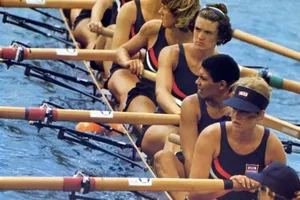
The regatta concluded with the women's eight, a crew featuring more than half of the legendary "Red Rose Crew." The eight won its repechage after finishing second in its heat before advancing to the A final. There, the U.S. women captured the bronze medal, finishing behind East Germany and the Soviet Union in a time of 3:38.16.
Coxswain Lynn Silliman was just a junior in high school when she helped steer the crew to an Olympic bronze medal. She later coxed for the Stanford men's team from 1978-1980. In the stroke seat was Jackie Zoch, a 1975 graduate of the University of Wisconsin and a member of the Red Rose Crew.
In the seven seat, Anita DeFrantz made an impact that extended far beyond rowing. She became the first and remains the only Black American woman to win an Olympic rowing medal. In 1986, she became both the first African American and the first woman elected to the International Olympic Committee. She was inducted into the U.S. Olympic & Paralympic Hall of Fame in 2025.
Six-seat Carie Graves went on to make the 1980 Olympic team before winning gold in the women's eight at the 1984 Olympic Games. In 1981, she helped win the women's coxed four at the Henley Royal Regatta, the first year women were allowed to compete at the event. Graves later served as the head coach at Harvard, Northeastern, and became the inaugural head coach at the University of Texas.
Marion Greig occupied the five seat after graduating from Cornell University in 1976. In the four seat was Anne Warner, who graduated from Yale in 1977 and became the first female Yale athlete to win an Olympic medal. Earlier that year, she was among the members of the Yale women's rowing team who led the now-famous 1976 Yale Women's Rowing Protest, a defining moment in the fight for Title IX equality. Their demonstration exposed the unequal treatment of the women's team and helped bring national attention to gender inequities in collegiate athletics.
In the three seat was Peggy McCarthy, another University of Wisconsin rower who later became a member of the victorious U.S. women's coxed four at the 1981 Henley Royal Regatta. Two-seat Carol Brown graduated from Princeton University, where she was both a rower and captain of the swim team. She earned a spot on the 1980 Olympic team and was also a member of the winning Henley crew. In the bow sat Gail Ricketson, a dual-sport athlete at the University of New Hampshire in rowing and skiing.
The crew was once again coached by Harvard University's Harry Parker, who guided the United States to consecutive international medals after leading the Red Rose Crew to silver at the 1975 World Championships and the Olympic eight to bronze in Montreal.
Legacy
Fifty years later, the legacy of Montreal continues to shape American rowing. On July 26, 2026, the U.S. U23 women's eight captured gold at the World Rowing U23 Championships in a shell fittingly named Montreal 1976, honoring the women who first carried the United States onto the Olympic stage.
Their legacy extends beyond medals. Many members of the 1976 team went on to coach, mentor, and develop future generations of rowers, while others became leaders in the broader Olympic movement. Anita DeFrantz, who won bronze in Montreal, became the first African American woman and the first woman elected to the International Olympic Committee.
The women of 1976 did more than break barriers on the water—they expanded what was possible. Fifty years later, every American woman who lines up at Youth Nationals, the NCAA Championships, the World Championships, or the Olympic Games follows a path first forged by these pioneers.